



What is Cutting Disc
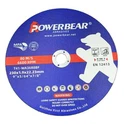
Often cutting discs, also known as cut-off wheels, are made from a solid abrasive disc. These discs are often used for cutting metal; They are composed of an abrasive mix of grit and adhesive that is formed into a thin, rigid disc with fiber webbing running through it for strength.
Speed and Efficiency
Cutting discs are designed to cut quickly and efficiently, reducing project time and boosting overall productivity.
Precision
These discs provide accurate cuts, ensuring clean edges and minimizing the need for additional finishing.
Versatility
With the ability to cut through various materials, a single cutting disc can serve multiple purposes, reducing the need for switching tools.
Portability
Handheld tools like angle grinders equipped with cutting discs offer portability, allowing you to take your cutting tasks to different locations.
Cost-Effectiveness
The durability and efficiency of cutting discs translate into cost savings, as they minimize material wastage and the need for frequent replacements.




Why Choose US
Our Factory
Founded in 2009, Guizhou First Abrasives Co., Ltd. is a professional company dedicated to the research, production, sales and services of resin bonded cutting wheels and grinding wheels. The company is located in Shuichang Industrial Park, Longli County, Guizhou Province, and covers an area of over 60000 m2, with a workforce of more than 300 employees.
Production Market
After more than a decade of development, the company's sales channels have expanded across the country, and its products are now exported to 20 countries and regions including Southeast Asia, Europe, America, and the Middle East.
Our Product
Powerbear is our conpany's best-selling brand in the word.We supply resin-bonded grinding wheel and flap disc.
Resin-boned grinding wheel: Involve cutting disc for metal,cutting disc for inox,2in1 cutting disc and grinding disc.
Flap disc: Invovle Aluminum Oxide Flap Disc,Calcined Aluminum Flap Disc,Zirconia Flap Disc.
Our Certificate
In 2019, the company became a national high-tech enterprise with an annual production capacity of 150 million pieces of cutting and grinding wheels. With advanced technology equipment and strong technical expertise, experienced production, and comprehensive testing methods, the company has obtained ISO9001 quality system certification and 21 unility model patent certificate.
Identify the material to be cut
Different cutting discs are designed for cutting specific materials. It's essential to select the right cutting disc for the task at hand to ensure it does not become damaged or cause injury.
Check the thickness of the material
The thickness of the material to be cut will determine the thickness of the cutting disc needed. Using a thin cutting disc on a thick material can cause it to wear down more quickly and break.
Consider the speed of the power tool
Most cutting discs come with a maximum RPM. It's essential to choose a cutting disc that can handle the speed of the power tool you're using.
Look for quality brands
Investing in a high-quality cutting disc is worth it as it will last longer and provide a cleaner cut. Look for reputable brands that manufacture cutting discs with high-quality materials.
Choose the right size
Cutting discs come in various sizes, and it's crucial to choose one that fits the power tool you're using. Using a cutting disc that is too small or too big can cause accidents.
Material of Cutting Disc
Cutting disc for aluminum
Aluminum is a lightweight material, coming in at about one-third the weight of steel. It is also often just as strong or stronger when produced using the right techniques and correct alloys. In addition to a high strength-to-weight ratio, aluminum has a nice finish and natural resistance to corrosion. This metal offers significant advantages, but working with it presents unique challenges. Aluminum has a low melting point and will load on abrasives.
Cutting disc for stainless steel
Stainless steel contains chromium, which gives this metal a protective layer against corrosion. Stainless steel resists but is not totally impervious to rust, so steps need to be taken during the production and fabrication process. It is essential to choose a cutting wheel made from abrasives compatible with stainless steel to ensure the workpiece isn't contaminated. The right cut-off wheel for stainless steel will increase efficiency, reduce rework and eliminate cross-contamination.
Cutting disc for steel
Compared to metals like aluminum and stainless steel, sheet metal is much easier to cut through. With sheet metal, the primary thing to consider is the wheel thickness. Thin (.045 inch) and ultra-thin (1 millimeter) wheels are best. These wheels remove less material at once to provide a faster and cleaner cut that creates less friction and generates less heat, reducing the chances for surface discoloration.
The installation of the cutting disc does have a front and back side.
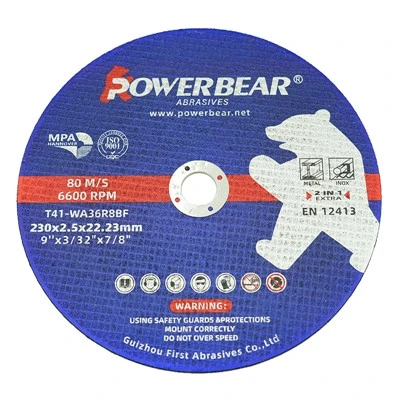
When installing the cutting disc, it is very important to correctly identify and distinguish the front and back sides. Usually, one side of the cutting disc will have special textures, trademarks, or arrows, which indicate the front side of the cutting disc. If there is no mark, it can be judged based on the shape and thickness of the cutting disc, and the thicker side is usually the front side. When installing the cutting disc, it should be placed on the countertop with the front side facing up and fixed with appropriate tools such as wrenches, screwdrivers, rubber hammers, etc. For cutting discs with holes, they can be fixed by tightening the screws; for cutting discs without holes, they can be gently tapped with a rubber hammer to make them firmly fixed. After installation, it is necessary to check whether the cutting disc is installed firmly and ensure that it will not loosen or fall off. In addition, the position of the grinding wheel needs to be adjusted to ensure that the edge of the cutting disc is aligned with the edge of the grinding wheel to avoid deviation. Finally, test run the cutting machine to check whether the cutting disc is working properly. If any problems are found, it should be stopped and checked immediately.
In particular, for cutting discs with trademarks, the trademark is facing up to facilitate installation and reduce swinging. In addition, it is correct to install the blade with the surface facing up, because this can provide good friction and prevent slipping. At the same time, the iron ring can be used as a gasket to simplify the process of unloading the slice. If the cutting disc is used for a long time, the mark on it can more intuitively show the degree of wear of the slice.
Application of Cutting Disc
General fabrication
In general metal fabrication, 0.045-inch wheel diameters are common choices. With thinner materials, an operator may want to choose a 1-millimeter disc instead for greater precision, less heat generation, and fewer burrs that will require removal before welding. The choice of grain will likely depend on the material composition of the workpiece - higher-performing grains for structural steel and difficult-to-cut metals, contaminant-free discs for stainless steel.
Pipe fabrication
In metal pipe fabrication, the choice of cutting disc often depends on the diameter of the pipe to be cut. For a 3/4-inch or smaller pipe, a 4 1/2-inch diameter will usually be sufficient. For a pipe of up to 2 1/2 inches, a 6-inch cutting disc is effective, and for a pipe of up to 3 1/2 inches, a 9-inch cutting disc is often most suitable. It's also advisable to choose the thinnest disc possible to minimize heat and friction and to use a type 1 wheel for a deeper cut unless the application imposes a particular constraint. For larger pipe often found on the pipeline, a depressed-center cutting disc provides added clearance when working at a constrained angle, and 0.045-inch disc thickness is ideal for cutting applications in fabrication yards or on the right of way for field repairs.
Shipbuilding
When an operator is working on the confined, hard-to-access spaces of a ship, making a cutting disc last as long as possible is often a priority. For this reason, the operator will often want to choose a harder, potentially longer-lasting wheel. However, when operators must use air tools whose hoses have stretched over long distances to access difficult areas of the ship, the tools may be underpowered. In this case, wheels with a soft bond will be ideal because they make it easier to maintain a fast cut. In shipbuilding, the work material often influences the cutting wheel selection. When working with aluminum, an operator may want to select a cutting disc that will not load or gum up.
Welding preparation
Preparing for welding typically involves exact metal cutting. With a basic cut-off operation, precision is not critical, but with complex work or repairs that need to preserve the initial aesthetic qualities of the material, precision can save time and money. Using a 0.045-inch cutting disc - A little more than a millimeter thick - is common in welding to allow for precise and accurate cuts.
Railways
Modern railways use hard-to-cut alloy steels, so a high-performance cutting disc is necessary for high-speed gas saws. A self-sharpening zirconia alumina grain that retains a high cutting performance throughout the life of the wheel offers excellent performance.
Construction
Building and construction sites feature a wide variety of metal cutting applications. Operators often look for a disc that can do it all, from cutting off rebar to making long cuts on sheet metal. Many times, an aluminum oxide disc provides the right mix of versatility, performance, and price.
What Are the Sizes of Cutting Discs

The specifications of cutting discs in the ultra-thin series include 105×1.2×16mm, 180×1.2×22mm, etc., which are suitable for cutting glass or thinner materials.
The specifications of cutting discs in the stainless steel series are 100×2×16mm, 400×3.2×32mm, etc., and the composite corundum material is used to speed up the cutting speed.
The specifications of cutting discs in the cast iron series and pneumatic tool series also include 100×2×22mm, 180×1.2×22mm, etc., which are suitable for different cutting needs.
In addition, there are many other specifications of cutting discs on the market, such as 4001.232, 3503.225, etc. These specifications are produced by different cutting disc manufacturers, but usually consist of three parameters: Outer diameter, thickness and aperture. For example, the specification of a cutting disc is 4003.232, which means its outer diameter is 400mm, thickness is 3.2mm, and hole diameter is 32mm. These diverse specifications and types enable cutting discs to adapt to a variety of different cutting tasks and materials.
How Does the Thickness of a Cutting Disc Affect Its Performance
Cutting Speed
The thickness of a cutting disc has a direct impact on its cutting speed. Thinner discs generally offer higher cutting speeds compared to thicker ones. This is because a thinner disc removes less material during each rotation, allowing for faster cutting. Thicker discs, on the other hand, require more material to be removed, resulting in a slower cutting process.
Durability
Thicker cutting discs tend to be more durable and have a longer lifespan. They can withstand higher levels of stress and are less prone to bending or breaking. This makes them particularly suitable for heavy-duty cutting tasks or materials that require more force to cut through. Thicker discs are often used in industrial settings where robustness and longevity are essential.
Precision
Thinner cutting discs offer better precision and accuracy during cutting operations. They produce narrower kerfs, which refers to the width of the cut. Thinner discs allow for more intricate and detailed cuts, making them ideal for applications where precision is crucial, such as in jewelry making or intricate metalwork. Thicker discs may result in wider cuts, leading to increased material loss.
Heat Dissipation
During cutting, friction generates heat, which can potentially damage the cutting disc or the material being cut. Thinner cutting discs dissipate heat more effectively compared to thicker discs. The reduced thickness allows for better heat transfer, enabling the disc to stay cooler during cutting. This improved heat dissipation helps prevent overheating, which can lead to disc warping or premature wear. Thinner discs are particularly advantageous when working with heat-sensitive materials.
Vibration and Stability
Thicker cutting discs tend to provide better stability and generate fewer vibrations during cutting operations. The increased thickness enhances the rigidity of the disc, reducing the likelihood of bending or flexing. This stability is particularly beneficial when cutting through hard or dense materials that require more force. It improves control over the cutting process and reduces the risk of accidents or damage to the workpiece.
Difference Between Cutting and Grinding Disk
A cutting disk and a grinding disk are two important tools that are commonly used in a variety of applications, from DIY projects to industrial settings. While both tools are used to shape and alter the surface of materials, they differ in their methods and outcomes.
A cutting disk is designed to cut through materials with ease. Its sharp teeth are engineered to slice through the surface of the material, creating a clean and precise edge. Cutting disks are commonly used for cutting through metal, masonry, and other hard materials. They are often used in construction, manufacturing, and fabrication projects, as well as for DIY applications.
On the other hand, a grinding disk is designed to remove material from a surface. Rather than cutting into the material, the grinding disk grinds away the surface layers of the material until the desired shape or level of smoothness is achieved. Grinding disks are commonly used for smoothing out rough edges, removing rust or paint, and sharpening tools.
There are several key differences between these two types of disks. The most obvious difference is in their appearance. Cutting disks have a series of sharp teeth around the edge, while grinding disks have a flat surface with abrasive particles embedded in it. Additionally, cutting disks tend to be thicker and heavier than grinding disks, as they need to withstand the force required to cut through hard materials.
Another important difference between cutting disks and grinding disks is the materials they are made from. Cutting disks are typically made from hardened steel, fiberglass, or abrasive ceramics, while grinding disks are made from a variety of materials, including aluminum oxide, silicon carbide, and diamond.
In terms of their applications, cutting disks are best suited for projects that require precise cuts and clean edges. They are commonly used to cut through metal pipes, stainless steel, and concrete. Grinding disks, on the other hand, are ideal for projects that require smoothing out rough surfaces or sharp edges. They are commonly used to grind down weld seams, remove rust or paint, and sharpen tools like chisels and mower blades.
Cutting discs are essential tools for various cutting tasks, such as metalworking, construction, and woodworking. To ensure their durability and longevity, proper storage is necessary. Here are some positive and effective storage methods for cutting discs:
Use designated storage containers: Store cutting discs in designated containers that are specifically designed for this purpose. These containers can prevent damage, warping, or cracks from exposure to moisture, dust, or other elements.
Keep in a dry location: Cutting discs should be stored in a dry location that is free from moisture and humidity. Moisture can cause rust and corrosion, which can weaken the blade and reduce its effectiveness.
Avoid stacking: Stacking cutting discs can cause them to rub against each other, leading to damage, warping, or chipping. Instead, store them separately in their containers or on a flat surface.
Label and organize: Organize cutting discs by size, type, or material and label them to make it easy to find the one you need. This can help save time and prevent damage from accidental mishandling.
Check regularly: Check cutting discs periodically for any signs of wear or damage. Replace any discs that are cracked, chipped, or showing signs of wear and tear to prevent accidents or damage to the tool or workpiece.
By following these positive and effective storage methods for cutting discs, you can ensure that they remain in good condition and perform well for longer periods, saving you time and money in the long run.
FAQ
We're professional cutting disc manufacturers and suppliers in China, specialized in providing high quality customized service. We warmly welcome you to buy high-grade cutting disc made in China here from our factory.
Cut off Wheel for Metal, Cutting Disc for Angle Grinder, cutting disc